Calcium Carbonate, Starch-Based, or PLA: Which Eco-Bag Is the Ultimate Packaging Answer for the Future?
As countries around the world place increasing emphasis on environmental protection, global green trade barriers rise, and consumer environmental awareness awakens, eco-friendly and biodegradable packaging bags have become an essential choice across all industries. In today's packaging market, three main options stand out: calcium-carbonate-modified eco-bags, starch-based biodegradable bags, and PLA (polylactic acid) biodegradable bags. Each has its own material characteristics suited to various packaging scenarios.
Many brand owners, purchasers, and packaging factories share the same question: among these three mainstream eco-bags, each with its own pros and cons, which one is the ultimate packaging solution for the future market—balancing environmental friendliness, cost, and practicality? Today, we will conduct an in-depth analysis of the core differences among the three eco-bags from five key dimensions: raw material properties, degradation capability, product performance, production cost, and market adaptability. Read on to understand the future trends in the packaging industry.
I. Starch-Based Eco-Bags: A Cost-Effective, Popularization-Oriented Eco-Solution
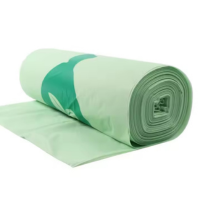
Starch-based eco-bags are the most widely adopted basic biodegradable packaging. Their core raw materials are natural plant starches—such as corn, cassava, and potato—blended with高分子 materials like PLA and PBAT. They are typical biomass eco-materials and were among the earliest mainstream alternatives to traditional plastic bags.
In terms of core advantages, the biggest highlights of starch-based materials are renewable raw materials, low cost, and mild degradation. Starch is a bulk agricultural commodity with a stable supply chain and controllable prices. The raw material cost per ton is far lower than that of pure PLA, allowing starch-based eco-bags to achieve mass adoption at affordable prices. They are well-suited for low-frequency, general-purpose scenarios such as supermarket shopping, ordinary takeaway packaging, and daily small-item packaging. Moreover, their biomass content can be decomposed by microorganisms in the natural environment without harmful residues, meeting basic environmental testing standards.
However, for long-term use and premium packaging needs, the shortcomings of starch-based eco-bags are very apparent. Natural starch is highly hydrophilic, resulting in poor water resistance and moisture resistance. The bags tend to soften and break when damp, and their mechanical stability is insufficient. Meanwhile, their heat resistance is weak; they deform easily under high temperatures, making them unsuitable for cold-chain transportation, hot-food packaging, or long-term storage. More critically, the degradation cycle of pure starch-based products is unstable. Most can only degrade efficiently under industrial composting conditions; their degradation efficiency drops significantly in natural landfill environments.
Overall, starch-based eco-bags are the most cost-effective transitional eco-solution, suitable for low-end general packaging. However, due to performance limitations, they cannot meet the high-end, complex, or long-term packaging needs of the future.
II. PLA Eco-Bags: The Premium Benchmark for Pure Biodegradation
PLA (polylactic acid) is currently the most recognized fully biodegradable material. Derived from plant sugars such as corn and sugarcane through fermentation and polymerization, it is a 100% renewable and fully degradable green polymer material, and the core choice for high-end eco-packaging. Most packaging bags labeled "fully biodegradable" in the market use PLA as the main base material, often blended with PBAT for performance optimization.
The core advantages of PLA eco-bags lie in their environmental credentials and product quality. They achieve 100% complete biodegradation, breaking down rapidly into carbon dioxide and water under industrial composting conditions, with no solid residue and no heavy metal pollution. Their environmental attributes are top-tier, fully compliant with the world's strictest environmental certification standards, making them suitable for export, premium brand packaging, food and pharmaceutical packaging, and other demanding applications. Additionally, PLA offers high transparency, a smooth texture, moderate hardness, and excellent printability, delivering far superior branding visual effects than the other two materials.
However, PLA's industry pain points are also prominent and constitute the biggest obstacle to its widespread adoption. First, the cost remains high. Limited by raw material production capacity and complex manufacturing processes, PLA resin prices are significantly higher than starch-based and calcium-carbonate-modified materials, leading to high end-product prices and substantially increasing packaging costs for businesses. Second, there are performance drawbacks. Pure PLA is brittle, lacks toughness, and has weak tensile and tear resistance. It tends to crack at low temperatures, and its degradation rate in natural environments is extremely slow; it can only degrade effectively under high-temperature industrial composting conditions, limiting its application scenarios.
Although domestic PLA production capacity is expanding and material costs have seen a slight decline, widespread affordability is still out of reach in the short term. PLA remains a niche solution for premium segments and cannot serve as a universal packaging choice across all industries.

III. Calcium-Carbonate-Modified Eco-Bags: The Future Mainstream Balancing Practicality, Eco-Friendliness, and Cost
Many people mistakenly believe that calcium-carbonate eco-bags are "pseudo-degradable" products. In reality, they are the most market-aligned and technologically mature composite eco-packaging solution available today. Calcium-carbonate eco-bags use modified nano-calcium carbonate as the core filler, blended with a small amount of polymer resin. The inorganic mineral content can reach over 30%, significantly reducing the use of petroleum-based resins and curbing plastic pollution at the source. They are an innovative and practical eco-material.
Compared with starch-based and PLA materials, the comprehensive advantages of calcium-carbonate eco-bags are exceptionally prominent:
-
First, extreme cost-effectiveness. Calcium carbonate is abundant and inexpensive, with simple production processes and short molding cycles. Production efficiency is much higher than for PLA and starch-based products, and the final price is only about 60% of that of PLA eco-bags, greatly reducing the cost of packaging transition for businesses.
-
Second, comprehensively upgraded product performance. Through modification processes, calcium-carbonate eco-bags exhibit toughness, tear resistance, tensile strength, water resistance, and heat resistance far surpassing starch-based products. They resist deformation and breakage and can be used across the full spectrum of scenarios—logistics, cold-chain packaging, industrial product packaging, daily shopping, etc.—solving the practical usability issues of traditional degradable bags. In addition, the alkaline nature of calcium carbonate neutralizes acidic by-products during degradation, precisely controlling the product's service life and preventing premature failure.
-
Third, environmental credentials that meet standards. Unlike traditional plastic bags, calcium-carbonate eco-bags gradually fragment and degrade under light and thermal-oxidative conditions, reducing microplastic residues and mitigating the risks of soil acidification and water eutrophication. When combined with biodegradable additives, composite products can achieve semi-degradable to fully degradable performance, fully complying with domestic and international plastic-restriction policies and suitable for export markets.
The only drawback is that pure calcium-carbonate materials cannot achieve rapid full degradation. However, as industry technology advances, calcium-carbonate + PLA/PBAT composite modification processes are becoming increasingly mature. These composites perfectly combine the cost-effectiveness and practicality of calcium carbonate with the full-degradation advantage of PLA, bridging the environmental gap and emerging as the most balanced packaging solution available.
IV. Final Recap: Who Will Dominate the Future Packaging Market?
After comprehensively evaluating performance, cost, environmental impact, and adaptability, we can clearly conclude:
-
Starch-based eco-bags are suitable for low-end general scenarios. They win on affordability but have obvious performance limitations and lack practicality.
-
Pure PLA eco-bags are suitable for high-end niche segments. They offer the highest environmental standards but are costly and limited in application scenarios, making mass adoption difficult.
Calcium-carbonate-modified composite eco-bags are the ultimate answer for the future packaging industry. They eliminate the core drawbacks of the other two materials, combining four major strengths: low cost, high practicality, strong adaptability, and sound environmental performance. They can meet the affordability needs of mass-market popularization while also achieving full-degradation standards through composite modification, serving premium export and brand packaging scenarios. They are the only packaging solution capable of covering all industries and all application scenarios.
V. Summary
As a professional plastic bag manufacturing factory, we have years of deep experience in the packaging industry and expertise in customizing calcium-carbonate-modified, starch-based, and PLA composite materials. Leveraging mature production systems and technical know-how, we can tailor eco-bags with different degradation levels and performance parameters according to customer scenario requirements. Our products not only meet global environmental certification standards but also strictly control production costs, helping businesses achieve green packaging upgrades and seize market opportunities.
The future of packaging is never a competition based solely on environmental attributes—it is a comprehensive competition of environmental friendliness, practicality, cost, and adaptability. The technological evolution of calcium-carbonate composite eco-bags is reshaping the eco-packaging landscape, making them the optimal alternative to traditional plastics and single-degradation materials, as well as the inevitable trend for green packaging upgrades across all industries. If you have any needs, please feel free to contact us. We, Qingdao Shimao, are here to serve you.
The Self-Cultivation of Food-Grade Plastic Bags: Odorless, Oil-Resistant, and Heat-Resistant
How Long Do Plastic Bags Last? The Inventory Cost You Must Calculate Before Bulk Stockpiling
Related Article